
Our Software
The Power of One
Buying groups, franchises, cooperatives, and other group purchasing organizations (GPOs) all exist to enable independent businesses to act as one. Whether it’s marketing as one, training as one, operating as one, or purchasing as one, it seems that ‘as one’ could be thought of as the official mantra of these groups. Interprise Software takes the concept of purchasing as one to a whole new level.
Buying groups and franchises recommend or require their members to purchase from preferred vendors, in return for preferential pricing or rebates. Interprise Software allows preferred vendors to maintain products, pricing and member account information for all members and enables members to place orders online 24/7 from any vendor using a single website. Vendors are able to receive all orders electronically in a single format and head office is able to generate detailed reports of all purchasing. Interprise Software makes it easy for franchises and buying groups to take advantage of the many benefits of purchasing as one.

Interprise Technology
Interprise Software is committed to utilizing the most progressive technology to deliver cost-effective solutions to buying groups and franchises. We employ modern techniques in server virtualization and cloud computing, enabling us to dynamically scale storage space and processing power.
The software is hosted on mirrored drive arrays in our secure enterprise data center, with fiber-optic connectivity to the Internet. Our infrastructure includes controlled HVAC, fire suppression, uninterrupted power supplies, and a diesel generator.
All of our clients receive our managed hosting service, which includes infrastructure upgrades, offsite backups, and a comprehensive disaster recovery plan. Our technology speaks for itself, with a track record of uptime that exceeds 99%, even when downtime for scheduled maintenance factored in.
Interprise Software is accessible through all the leading operating systems and browsers. In addition to the special features for buying groups and franchises that are simply not available in other enterprise solutions, Interprise Software employs a number of advanced features that enable users to: dynamically change the columns shown on pages, sort and filter data based on custom criteria and create custom PDF/CSV (Excel) reports from search results. And quite unique to Interprise Software, is the capability for an authorized administrative user of a company to impersonate any other user in their company and see exactly what that user would see.
From world-class infrastructure to industry-leading software features, Interprise Software helps buying groups and franchises capitalize on the latest innovations in technology.
Roles and Permissions
Interprise Software is designed to empower all users, freeing up valuable time for head-office to focus on marketing, accounting, strategic planning and other issues that are important to them. Every company has one or more administrator users, who have access to every resource that has been granted to that type of company (e.g. members, vendors, etc.). Administrators can create an unlimited number of user roles, with varying permissions. When adding users, administrators assign the user one or more roles, which the user will be able to quickly switch between (e.g. Sales Clerk, Lab Tech, etc.). Any user can update their own information, change their password, or get instant help if they have forgotten their password.
Multi-Language
Interprise Software includes a sophisticated localization module that presents all pages seamlessly in multiple languages and manages the translation process. All text is stored separately, so that it can be easily translated into the supported languages. Our content manager can be set up to enable simple editing of static content in any supported language. Interprise Software detects the locale of the user and displays the content in the appropriate language. Of course, users have the ability to change their language preference if desired, and this preference is maintained on subsequent visits.
Central Billing
Large groups take advantage of a concept called central billing to consolidate orders and invoices for all their member locations. Vendors will pay central billing administration (CBA) fees for the privilege of receiving orders electronically for all member locations, and electronically invoicing head office for all purchases. The income from CBA fees can exceed the entire cost of system and provide recurring revenue to fund additional programs for the group. The illustration below shows how it works (mouse over the steps).
- Ordering
Orders entered by the member or their sales rep are sent electronically to the vendor.
- Shipping
Orders are billed to head office, but drop-shipped to the retail location placing the order.
- Vendor Invoicing
The vendor invoices head office for the order via EDI or through the system.
- Head Office Invoicing
The system automatically invoices the member on behalf of head office.
- Payment to Head Office
The member makes one electronic payment to head office for purchases from all vendors.
- Payment to Vendor
Head office makes one electronic payment to the vendor for purchases made by all members.
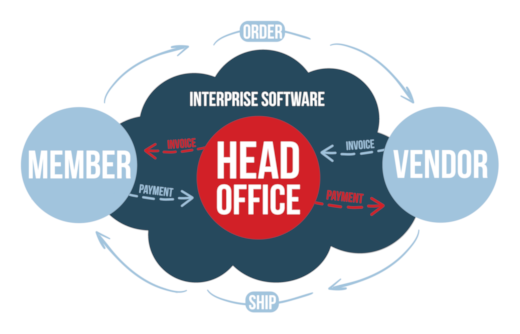
Interprise Software is designed to handle the special requirements of central-billing buying groups and franchises. Most groups avoid central billing because of the manual administration associated with placing orders on behalf of members, processing invoices from suppliers and re-billing members for orders. Interprise Software equips members and vendors to administer ordering and invoicing, while automating the calculation and crediting of CBA fees against payments to vendors. This makes it possible for the buying groups and franchises to easily capitalize on, and profit from, the central billing advantages enjoyed by large chains such as Costco and Wal-Mart.
Interprise Software Portals
The Interprise Software architecture has been designed to take self-maintenance to a whole new level. The system is built around a number of portals that are used by different groups of users. Find out more about the vendor portal, member portal, and head office portal.
Case Study: Foto Source Canada Inc.
Foto Source is Canada’s largest buying and marketing group for photographic members, with over 225 stores across the country. Read about how this leader in the photo industry automated their supply chain and took advantage of the central billing features in Interprise Software.
Subscribe
Get email updates from Interprise Software.

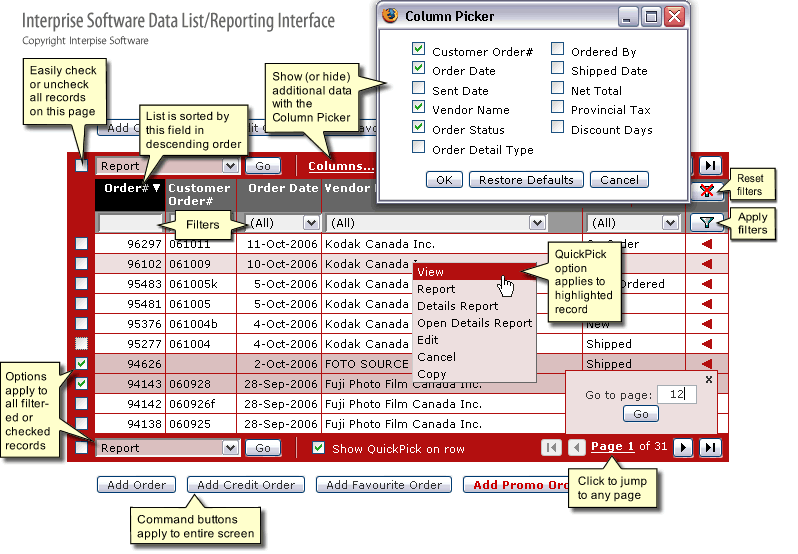
Interprise Software’s intuitive, feature-rich interface. See detailed example.